Koala AI vs Autoblogging.ai for Automated Internal Linking
You are comparing two tools for one job: automated internal linking. Pick wrong and you are stuck updating old posts by hand, or worse, paying monthly for a feature that never touches your existing archive.
By the end of this article you will know exactly how Autoblogging.ai and Koala AI handle automated internal linking, what each charges, and which integrations and publishing workflows they support. You will also get a clear verdict on which tool fits bloggers, agencies, and site owners, so you can decide without testing both.
Quick Verdict: Koala AI vs Autoblogging.ai for Automated Internal Linking
For most SEO professionals and agencies focused on automated internal linking at scale, Autoblogging.ai edges out Koala AI due to its dedicated link optimization engine, broader integration ecosystem, and credit rollover. The distinction matters because internal linking is not a side task in modern SEO automation. It shapes site architecture, crawlability, and how link equity moves through your pages.
Autoblogging.ai pairs AI content generation with native internal link automation, so content production and link placement work as one system rather than two disconnected steps. Koala AI remains a capable general-purpose AI writer, but it does not offer specialized link automation as a core function.
| Criteria | Autoblogging.ai | Koala AI |
|---|---|---|
| Core focus | AI content generation plus internal link automation | General-purpose AI writing |
| Internal linking | Dedicated link optimization engine | No specialized link automation |
| Integrations | 35+ integrations | Limited, mostly general publishing tools |
| Publishing | One-click WordPress publish | Standard export and publishing options |
| SEO tooling | SERP competitor analysis, semantic SEO tools, 21-point SEO audit | Basic on-page content assistance |
| Credits | Credits rollover | Varies by plan |
| Track record | 40,000+ content creators, 4.9 rating, 1M+ articles generated | Established but narrower SEO workflow |
The scale numbers tell a useful story. Autoblogging.ai is trusted by 40,000+ content creators with a 4.9 average rating and more than 1M articles generated. That volume suggests the platform handles internal linking reliably across large content libraries, not just small test sites.
Koala AI's strengths sit in content generation, where it produces readable drafts and supports common writing workflows. What it lacks is a purpose-built layer for internal link optimization, which means teams often handle link insertion, anchor text choices, and URL mapping manually or through separate plugins.
- Choose Autoblogging.ai when automated internal linking, semantic relevance, and WordPress publishing need to run inside one workflow.
- Choose Koala AI when you mainly need a general AI writer and plan to manage internal links with other tools.
- Consider hybrid setups only if your team already has a mature linking process and wants a second drafting option.
Autoblogging.ai also supports 10+ AI modes, 35+ languages, and one-click WordPress publish, all of which feed into a more connected SEO automation pipeline. For readers whose priority is internal link optimization at scale, the verdict is straightforward: Autoblogging.ai is the stronger fit.
At a glance: how Autoblogging.ai compares to Koala AI, Autoblogging.ai for Automated Internal Linking on the features that matter most.
| Feature | Autoblogging.ai | Koala AI | Autoblogging.ai for Automated Internal Linking |
|---|---|---|---|
| Automated Internal Linking | ✓ | ✓ | ✓ |
What Is Autoblogging.ai?
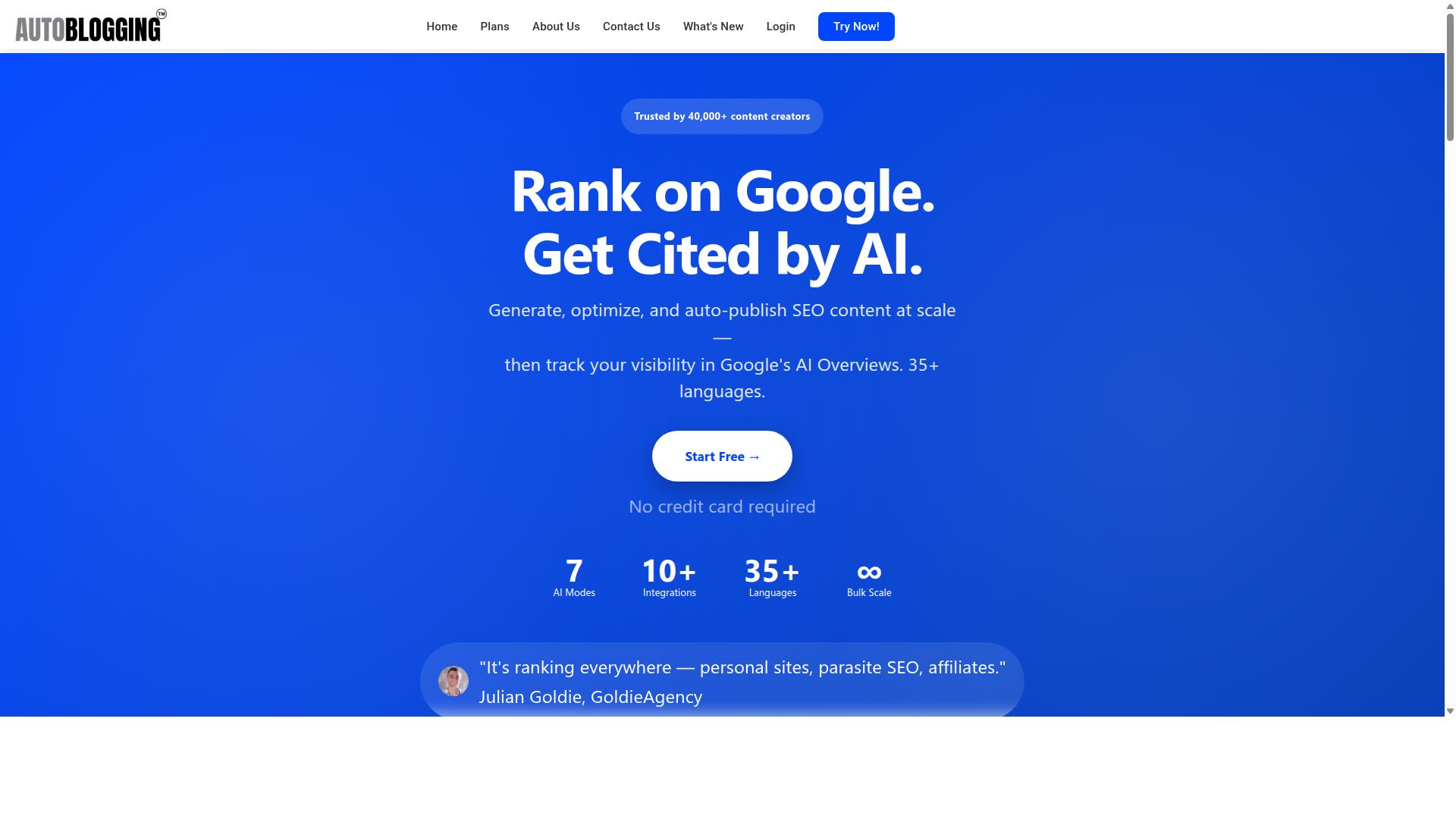
Autoblogging.ai is a SaaS platform developed by Digimetriq that automates AI article generation and internal linking for bloggers, agencies, and SEO professionals. Founded in 2022 by Vaibhav Sharda, the platform grew out of Digimetriq's existing expertise in process automation.
That origin matters for anyone comparing AI content tools. Instead of building a writing assistant first and bolting on SEO features later, Autoblogging.ai was designed around workflow automation from the start. The goal is simple: cut content costs while giving human writers a strong first draft to refine.
The stated mission is to help bloggers, website owners, and agencies save time and improve their online presence through technology. Digimetriq frames this as a two-stage vision. Autoblogging.ai supports human counterparts within standard operating procedures by producing the first draft, while Digimetriq's broader aim is to eventually replace those manual steps entirely.
The adoption numbers back up that positioning. Autoblogging.ai reports more than 40,000 content creators and over 1 million articles generated across its platform.
Its feature set spans 10+ AI modes, 35+ languages, and 35+ integrations. Those figures matter in a comparison against Koala AI because they show the platform is built for scale, not just one-off blog posts.
Autoblogging.ai serves a global audience as an online product, so users are not tied to a single region or market. For teams evaluating SEO automation tools, that combination of automation depth and international reach is the core of what the platform offers.
- Founded: 2022, by Vaibhav Sharda
- Parent company: Digimetriq
- Users: 40,000+ content creators
- Output: 1M+ articles generated
- Capabilities: 10+ AI modes, 35+ languages, 35+ integrations
The takeaway for this comparison: Autoblogging.ai positions itself as a broader automation layer for content production and internal linking, while Koala AI is generally known as a writing-focused AI tool. That distinction shapes everything that follows.
What Is Koala AI?
Koala AI is a general-purpose AI writing assistant that helps users generate blog posts, product descriptions, and other content using large language models. It has become popular among marketers and bloggers who want a fast way to produce drafts without wrestling with complex prompts or technical setup.
The tool's main appeal is ease of use. Its template library lets users pick a content type, enter a topic or keyword, and receive a structured draft in minutes. For solo bloggers and small teams, that simplicity lowers the barrier to publishing consistently.
Koala AI also connects with some SEO workflows. Users can generate meta descriptions, outlines, and article bodies, then move that content into a CMS for publishing. These integrations are useful, but they focus on content creation rather than site-wide link management.
That distinction matters for this comparison. Internal linking is a structural task: it involves mapping URLs, choosing anchor text, and placing contextual links across an entire site. Koala AI does not offer native automated internal linking capabilities, so any link building around its output has to be handled manually or with a separate tool.
In short, Koala AI is best understood as a writing engine. It can help you fill pages with text, but it will not scan your existing content, identify orphan pages, or redistribute link equity on its own. Readers comparing it to a dedicated internal linking platform should weigh that gap carefully.
What Is Autoblogging.ai for Automated Internal Linking?
Autoblogging.ai's automated internal linking module analyzes your existing content to automatically insert contextual links, optimize anchor text, and build a logical internal link graph without manual effort. Rather than treating internal links as an afterthought, the platform folds link insertion into its broader SEO automation workflow.
The system scans your site to map which pages exist and what each one covers. It then identifies relevant pages based on semantic relevance and entity linking, so a link is placed because the two pages genuinely relate, not because they happen to share a keyword.
That distinction matters. Generic AI content tools typically generate text and stop there. Internal link optimization is left to the writer or a separate plugin, which is why so many sites end up with uneven site architecture and weak topical authority signals.
Autoblogging.ai handles the link layer directly. Key capabilities include:
- Scanning existing content to find natural link placement opportunities
- Inserting contextual links based on semantic relevance and entity linking
- Optimizing anchor text so it reflects the target page's topic
- Supporting both dofollow and nofollow attributes where appropriate
- Avoiding broken links and redirect chains that waste link equity
- Helping surface and fix orphan pages that receive no internal links
Those last two points are easy to overlook. Broken links and 404 errors interrupt crawlability, while redirect chains dilute PageRank flow before it reaches the destination. Orphan pages, meanwhile, can be perfectly good content that search engines rarely discover because nothing on the site points to them.
This is where the module separates itself from a standalone AI writer. Content generation and internal link optimization live in the same platform, alongside tools like the Site Optimizer, Semantic SEO Analysis, Topical Maps, and Intense Optimizer. For teams running programmatic SEO or autoblogging at scale, that combination reduces the manual URL mapping and bulk editing that internal linking usually demands.
It also fits the platform's wider automation mission. Autoblogging.ai covers article generation through modes such as Quick Mode, Godlike Mode, Bulk Generation, News Mode, and Amazon Reviews Mode, then extends into publishing through WordPress integration, Web 2.0 platforms, and multi-platform support. Internal linking sits inside that same pipeline, so a site can grow its content library and its internal link graph together instead of retrofitting structure later.
Features Compared
This section compares the feature sets of Autoblogging.ai and Koala AI across automated internal linking, content generation modes, semantic SEO, integrations, and publishing workflows.
The two tools approach the market from different angles. Autoblogging.ai emphasizes automation and scale, with specialized tools for internal link optimization and bulk publishing built into the platform. Koala AI centers mainly on content generation, which means linking and site structure tasks tend to fall outside its core focus.
That distinction shapes everything below. For teams running large content operations, the gap in dedicated linking features is often the deciding factor.
Automated Internal Linking Capabilities
Autoblogging.ai provides a dedicated automated internal linking engine that scans your content, identifies linking opportunities, and inserts contextual links with optimized anchor text, whereas Koala AI does not offer native internal linking automation.
The engine relies on NLP and semantic relevance to decide which pages should connect. Rather than matching keywords alone, it evaluates meaning, so a link between two articles makes sense to readers and to search engines alike.
Several capabilities support stronger site architecture:
- Content silos that group related pages into tightly themed clusters
- Topical authority building across a niche or category
- Orphan page detection to surface content with no inbound internal links
- Link equity distribution across priority pages
- PageRank flow optimization to strengthen important URLs
Link velocity and density settings give you control over how aggressively links are added, which matters for sites that publish frequently. This kind of internal link optimization also improves crawlability, since search engine bots can move through a well-connected internal link graph more efficiently.
Koala AI, by contrast, is best described as a content-first tool. Based on publicly available information, it does not appear to include a built-in automated internal linking system, so users typically handle link insertion manually or rely on third-party tools. Its feature set may evolve over time, so it is worth checking current documentation before making a decision.
For teams that treat internal linking as a core SEO function rather than an afterthought, Autoblogging.ai's dedicated engine removes a substantial manual workload.
Content Generation Modes and Semantic SEO
Autoblogging.ai offers multiple content generation modes including Quick Mode for free single articles and Godlike Mode for SERP competitor analysis, LSI keyword integration, and knowledge graph extraction, while Koala AI provides a range of templates and AI writing modes.
The mode structure matters because not every task needs the same depth. Quick Mode suits fast drafts, while Godlike Mode is built for competitive topics where you want the article grounded in what already ranks. Bulk Generation supports up to 500 articles via CSV, and additional modes cover news content through Google News integration and Amazon reviews.
On the semantic side, Autoblogging.ai leans on LSI keywords and knowledge graphs to help content cover a topic rather than a single phrase. That approach pairs naturally with automated internal linking, because semantically rich pages give the linking engine more meaningful relationships to work with. Supporting tools like Semantic SEO Analysis, Topical Maps, and Fan Out Queries extend that coverage further.
The platform also supports 35+ languages, which matters for multilingual sites where internal links need to stay within the correct language version.
Koala AI focuses on general AI writing, with templates and modes aimed at producing articles and marketing copy. Specific claims about its semantic SEO depth are hard to verify from public materials, so it is fair to say its strength lies in writing output rather than in the semantic layer that feeds internal linking.
For bulk generation combined with semantic optimization, Autoblogging.ai holds a clear structural advantage.
Integrations, Languages, and Publishing Workflow
Autoblogging.ai supports 35+ integrations including WordPress, sitemap integration, and bulk editing, with a publishing workflow designed for scale, whereas Koala AI offers integrations with popular platforms but may lack the same depth in automated publishing.
The WordPress integration covers unlimited sites with one-click publishing, a plugin option, and scheduled auto-posting. Beyond WordPress, the platform connects to Web 2.0 destinations such as Medium, Dev.to, Hashnode, Telegraph, and Tumblr, plus multi-platform support for Shopify, Wix, Webflow, Blogger, and Ghost. An API, Zapier, and n8n round out the connection options.
These integrations do more than save clicks. XML sitemap integration and URL mapping give the linking engine a clear picture of your site structure, which helps it place links where they support site architecture instead of creating redirect chains or pointing at broken URLs. Bulk editing keeps large libraries manageable as they grow.
For agencies and high-volume publishers, the workflow is the real differentiator. Scheduled posting, multi-site publishing, and a Content Repurposer mean content moves from draft to live without manual steps between each stage, and internal links are handled along the way.
Koala AI connects with common platforms, and general references to WordPress and Zapier integrations are reasonable, but the specifics of its publishing automation are less clear from public information. Teams needing deep programmatic SEO workflows may find it lighter on that front.
Where publishing at scale is the priority, Autoblogging.ai's integration depth and language coverage give it the edge.
Pricing Compared
This section compares the pricing structures of Autoblogging.ai and Koala AI, focusing on plan tiers, credit systems, and scalability for different user needs.
Cost matters because automated internal linking is rarely a one-off task. It runs continuously as new content publishes, so the pricing model you choose shapes your long-term SEO automation budget.
Autoblogging.ai uses a credit-based system with both monthly and annual plans. Credits map directly to work performed, including article generation and internal linking tasks, and unused credits roll over so nothing goes to waste.
Koala AI, by contrast, takes a subscription-based approach. Its tiers generally scale with usage limits or feature access rather than a transferable credit balance, which changes how you plan for spikes in internal link optimization work.
The two models suit different workflows. A credit pool rewards teams that batch internal linking projects, while a flat subscription suits steady, predictable output. The subsections below break down each structure in detail.
Autoblogging.ai Plans and Credit Value
Autoblogging.ai offers monthly plans starting at $19 for 40 credits up to $999 for 5,000 credits, with annual discounts and credit rollover, providing flexible scalability for individuals and agencies.
The full monthly lineup is straightforward to compare:
- Starter: $19 for 40 credits
- Regular: $49 for 120 credits
- Standard: $99 for 300 credits
- Gold: $179 for 600 credits
- Premium: $249 for 1,000 credits
- Enterprise: $999 for 5,000 credits
Annual billing lowers the effective monthly rate on every tier. For example, Starter drops to $12 per month ($148 per year) and Enterprise to $649 per month ($7,792 per year), with similar savings across the middle plans.
Credits cover article generation and internal linking tasks, so the same balance funds both content creation and link insertion work. All plans include credits rollover, meaning unused capacity carries forward instead of expiring at the end of a billing cycle.
New accounts also receive 10 free credits per month with no credit card required, and additional credits can be purchased when a project needs a short-term boost. For high-volume users running programmatic SEO or managing many sites, the larger tiers deliver far more capacity per dollar than entry plans. Payment options include Visa, MasterCard, American Express, and PayPal, with bank transfers available for annual enterprise plans, and you can cancel anytime.
Koala AI Pricing and Scalability
Koala AI offers subscription-based pricing tiers that scale with usage, though specific plan details should be verified on their website as they may change.
As of this writing, Koala AI typically provides a free trial alongside paid plans that are structured around word count or feature access. That model works well for writers who need steady content output within a fixed monthly ceiling.
The trade-off appears at scale. When internal link optimization spans thousands of pages, or when link velocity needs to spike during a site migration or content silo rebuild, subscription caps can become a constraint. There is no credit pool to draw down and no rollover to bank unused capacity for a heavier month.
For very high-volume automated internal linking, Autoblogging.ai's credit system offers more headroom. A team can move from the $19 Starter plan to Premium or Enterprise as link insertion demands grow, then scale back without losing accumulated credits.
Readers comparing the two should check Koala AI's current pricing page directly, since subscription terms and usage limits shift over time. The key structural difference remains: Koala AI sells ongoing access, while Autoblogging.ai sells flexible, rollover-protected capacity that stretches further as internal linking needs expand.
Who Should Choose Autoblogging.ai
Autoblogging.ai is ideal for SEO professionals, marketing agencies, and affiliate marketers who need to automate both content generation and internal linking at scale. Instead of treating these as separate jobs handled by separate tools, the platform brings them into one workflow, which matters when a single site can hold hundreds of pages that all need sensible links between them.
The audience list is broad on purpose. It covers bloggers, website owners, SEO professionals, marketing agencies, content creators, and affiliate marketers, and the sites they run vary just as widely. That range explains why automated internal linking appeals to so many different operators.
If you manage one small blog, manual link insertion is manageable. If you manage ten sites, or one site with thousands of posts, it stops being manageable very quickly. That is the dividing line this section addresses.
Multi-site operators get the clearest benefit. Anyone running several properties at once faces the same repetitive task on every domain: deciding which pages should link to which, writing anchor text, and keeping the whole internal link graph coherent as new content publishes.
- Parasite SEO campaigns, where fast indexing and strong internal signals matter
- Affiliate sites, where link equity needs to flow toward money pages
- Client websites, where agencies must deliver consistent on-page SEO across accounts
- Portfolio sites, where many properties share one content pipeline
- Local sites, where service and location pages need tight interconnection
Each of these setups depends on the same underlying need: a site architecture that search engines can crawl and understand without manual intervention on every page.
Automated internal linking supports that architecture in three ways. First, it strengthens topical authority by connecting related pages so clusters read as deliberate content silos rather than isolated posts. Second, it improves crawlability and helps reduce orphan pages that no internal link points to.
Third, it saves time. Link insertion, anchor text selection, and URL mapping are repetitive tasks that scale badly when done by hand. Automating them frees an operator to focus on strategy, keyword research, and content quality instead of spreadsheet maintenance.
That combination of content generation and link management is where Autoblogging.ai positions itself. It is built for people who publish at volume and need the internal link structure to keep pace automatically, rather than being rebuilt after every batch of new posts.
Social proof matters here too. With more than 40,000 users, the platform has been adopted widely enough that its workflow is familiar to a large base of bloggers, agencies, and affiliate marketers. That scale suggests the approach works for the kind of multi-site, high-volume publishing this audience typically runs.
By contrast, Koala AI is often discussed as an AI content tool, and its internal linking capabilities are generally described in more limited terms. For someone whose main pain point is content volume alone, that may be sufficient. For someone who also needs consistent internal link optimization across many pages and properties, the automation gap becomes the deciding factor.
The practical takeaway: if your bottleneck is producing articles, either category of tool can help. If your bottleneck is keeping a growing site internally linked, structured, and crawlable, Autoblogging.ai is the stronger fit for the audience described above.
Who Should Choose Koala AI
Koala AI is suitable for individual bloggers, small business owners, and content creators who primarily need an AI writing assistant and do not require advanced automated internal linking. If your main goal is producing articles quickly and you are comfortable handling links yourself, a writing-first tool can feel like the simpler path.
This group tends to share a few practical traits. They usually run smaller sites where a handful of manual links per post is manageable. They often work alone, so ease of use matters more than automation depth. And they may prefer paying for one focused tool rather than a broader platform with features they will not touch.
Understanding where a writing assistant stops being enough helps you decide. The signs below are worth checking against your own workflow before committing.
- You publish a low volume of posts and can add contextual links by hand in a reasonable amount of time.
- Your site is small enough that site architecture and content silos stay easy to track mentally.
- You are not worried about orphan pages, link equity, or PageRank flow across dozens of categories.
- You prefer a tool that focuses on content generation rather than link management.
For these users, the trade-off is straightforward. You save on complexity and possibly cost, but you take on the linking work yourself. That means manually choosing anchor text, avoiding broken links and redirect chains, and keeping older posts updated as your library grows.
It may also appeal to those who simply prefer a simpler tool, even if a more capable option exists. Some creators like staying close to every edit, and that hands-on control has real value for them. The key question is whether that preference still holds once your archive reaches a size where internal link optimization becomes a recurring chore.
If your site is growing, publishing frequently, or targeting competitive topics that depend on topical authority and semantic relevance, a writing-only approach tends to strain. At that point, evaluating a platform built around automated internal linking alongside content creation becomes the more practical comparison.
Who Should Choose Autoblogging.ai for Automated Internal Linking
For agencies and SEO teams specifically focused on automated internal linking, Autoblogging.ai is the clear choice due to its dedicated link optimization engine, bulk processing, and integration with content generation. The platform was built around the idea that publishing at scale only works when the links between pages are handled at the same scale.
That combination matters because internal linking is rarely a one-time task. Every new article creates new opportunities for contextual links, new anchor text variations, and new demands on site architecture. Teams managing hundreds of pages across multiple sites need a system that keeps up, not a manual checklist.
Autoblogging.ai fits that need through its Site Optimizer and Intense Optimizer, which sit alongside the platform's article generation modes. Instead of treating link building as a separate project, the workflow connects content generation with internal link optimization from the start.
The platform also supports publishing through WordPress integration with unlimited sites, one-click posting, a plugin, and scheduled auto-posting. For teams running programmatic SEO across several properties, that removes a major bottleneck between writing content and getting it live with its links intact.
Here is where Autoblogging.ai's feature set lines up with the internal linking problems that matter most:
- Contextual link insertion: links placed where they make sense within the body of a page, not just in footers or sidebars
- Anchor text optimization: varied, relevant anchor text that supports semantic relevance instead of repeating the same phrase
- Orphan page fixing: pages with no inbound internal links get connected back into the site's link graph
- Link equity distribution: PageRank flow spread across priority pages rather than pooling on a handful of URLs
- Link velocity and density: controls that keep link growth and per-page link counts within reasonable bounds
- Sitemap integration: XML sitemap data helps the system understand which URLs exist and which need linking
Bulk processing is the other differentiator. Autoblogging.ai supports Bulk Generation of up to 500 articles via CSV, and the same scale-oriented thinking applies to optimization. Agencies handling many client sites can work through large URL sets rather than editing pages one at a time.
By contrast, Koala AI is primarily an AI writing tool. It can produce articles and assist with content workflows, but it does not offer native internal linking automation in the way Autoblogging.ai does. Teams using Koala AI typically still need a separate process, plugin, or manual pass to handle contextual links, anchor text, and orphan pages.
That gap is the deciding factor for this audience. If content generation is the main goal, either tool can be part of the stack. If automated internal linking across many pages or sites is the priority, Autoblogging.ai addresses it as a core capability rather than an add-on.
The platform also connects to Web 2.0 destinations including Medium, Dev.to, Hashnode, Telegraph, and Tumblr, plus multi-platform publishing for Shopify, Wix, Webflow, Blogger, and Ghost, along with API, Zapier, and n8n access. For teams whose internal link strategy spans more than one CMS, that reach keeps the link graph consistent across properties.
Autoblogging.ai is the stronger fit for agencies, SEO teams, and programmatic SEO operators who need internal link optimization to run alongside content production at volume. Koala AI remains a reasonable writing assistant, but it leaves the linking layer to other tools and manual effort.
Final Verdict
After comparing features and pricing, Autoblogging.ai emerges as the superior choice for automated internal linking, backed by its 40,000+ users, 4.9 rating, and 1M+ articles generated.
The deciding factor is specialization. Internal linking is not a side feature bolted onto a general writing tool. It is a core capability at Autoblogging.ai, and that focus shows in how the platform handles contextual links, anchor text, and site architecture at scale.
Koala AI remains a capable general AI writer. For teams that need straightforward content generation, it is a reasonable option. But when the goal shifts to automated internal linking, a generalist tool rarely matches a purpose-built system.
Here is how the two stack up on the factors that matter most for internal link optimization:
| Factor | Autoblogging.ai | Koala AI |
|---|---|---|
| Core focus | Specialized internal linking automation | General AI content writing |
| Credit rollover | Yes | Not a stated specialty |
| Integrations | 35+ integrations | General toolset, not link-focused |
| Pricing range | $19 to $999 plans | General AI writer pricing |
| Scalability | Scales with site size and content volume | Limited link-specific scaling |
The credit rollover policy deserves a closer look. Unused credits carrying forward means teams planning large link-building campaigns are not forced to burn capacity on a fixed schedule. That flexibility matters for programmatic SEO projects where content output varies month to month.
With 35+ integrations, Autoblogging.ai fits into existing workflows rather than demanding a rebuild. For publishers managing WordPress plugins, sitemap integration, and bulk editing, that compatibility reduces friction. The $19 to $999 plan range also means a solo blogger and an agency can both find a tier that fits, scaling up as their internal link graph grows.
None of this is to dismiss Koala AI. It writes well and serves many content needs. But internal linking demands more than clean prose. It requires understanding of link equity, PageRank flow, orphan pages, and semantic relevance. Those are specialist concerns, and Autoblogging.ai treats them as such.
For readers whose priority is automated internal linking rather than general writing, the recommendation is clear. Autoblogging.ai's focused toolset, rollover credits, integration depth, and flexible pricing make it the stronger pick for SEO automation at scale.
To explore the platform or ask questions before committing, reach out directly:
- Email: [email protected]
- Phone/WhatsApp: +91 84605-06553
- Availability: 7:00 to 19:00 IST
You can also visit the India office at 501, Trinity Orion, Vesu, Surat 395007, Gujarat, or the United Kingdom location at 2nd Flr, SEO Content Suite, 35 Water Ln, Wilmslow, Cheshire SK9 5AR. The team is available during business hours to walk through how internal linking automation fits your site.
Frequently Asked Questions
What is the difference between Koala AI and Autoblogging.ai for automated internal linking?
Both tools help automate parts of the content workflow, but they come at internal linking from different angles. Koala AI is primarily an AI article writer with its own feature set and pricing tiers, while Autoblogging.ai is built around generating and publishing content at scale, with internal linking handled as part of that process. If internal linking is a core priority for your site, it's worth testing how each tool fits your specific workflow.
How does Autoblogging.ai handle internal linking during article generation?
Autoblogging.ai includes internal linking as part of its article generation workflow, so links can be added as content is created rather than as a separate manual step. For example, a batch of 8 articles with AI images and internal linking uses 24 credits, which gives you a clear sense of how linking factors into credit usage. This makes it practical to keep internal links consistent across large volumes of content.
How does pricing compare between the two tools?
Koala AI's published pricing starts at $25/month for its Starter tier and scales up through several higher plans, with 20% savings on annual billing. Autoblogging.ai's monthly plans start at $19 for Starter (40 credits) and range up through Regular, Standard, Gold, Premium and Enterprise tiers, with credits that roll over. Since the two tools structure their plans differently, the best fit depends on your content volume and how heavily you rely on internal linking.
Can Autoblogging.ai handle internal linking at scale for agencies and multiple sites?
Yes. Autoblogging.ai supports Bulk Generation of up to 500 articles via CSV, which is well suited to agencies and portfolio or client sites where internal linking needs to be applied consistently across many pages. Credits roll over, so larger batches don't force you to waste unused capacity. It's used by bloggers, SEO professionals, marketing agencies and affiliate marketers worldwide.
Does Autoblogging.ai offer a free way to try automated internal linking?
Autoblogging.ai's Quick Mode is free and available as a single or wizard mode, so you can explore the platform before committing to a paid plan. The site notes that the free plan includes 10 a month, and a standard article is 1 credit. Koala AI also advertises a free start with no credit card required, so both tools let you evaluate them before paying.
Which tool is the better choice for automated internal linking?
That depends on your priorities: Koala AI is a capable AI writing tool with a broad set of pricing tiers, while Autoblogging.ai is designed around high-volume content generation with internal linking built into the workflow. Autoblogging.ai is trusted by 40,000+ content creators, holds a 4.9 average rating, and has generated over 1M articles, with new features shipped weekly and 24/7 support. For teams producing content at scale who want linking handled as part of generation, Autoblogging.ai is a strong fit.
Recommended Resources: