Google Sheets Automation AI Pricing: What Should You Pay?
Google Sheets automation AI can cost you anywhere from a few dollars to several hundred per month. Most teams overpay because they bundle task tracking into tools they barely use. You need a clear number before you commit.
This article breaks down typical price ranges for Google Sheets AI automation, explains why Tasks.Bot charges ₹200 per member per month, and shows what you get at each tier. By the end, you will know exactly which plan fits your team and whether a free trial is worth starting.
What Is Tasks.Bot?
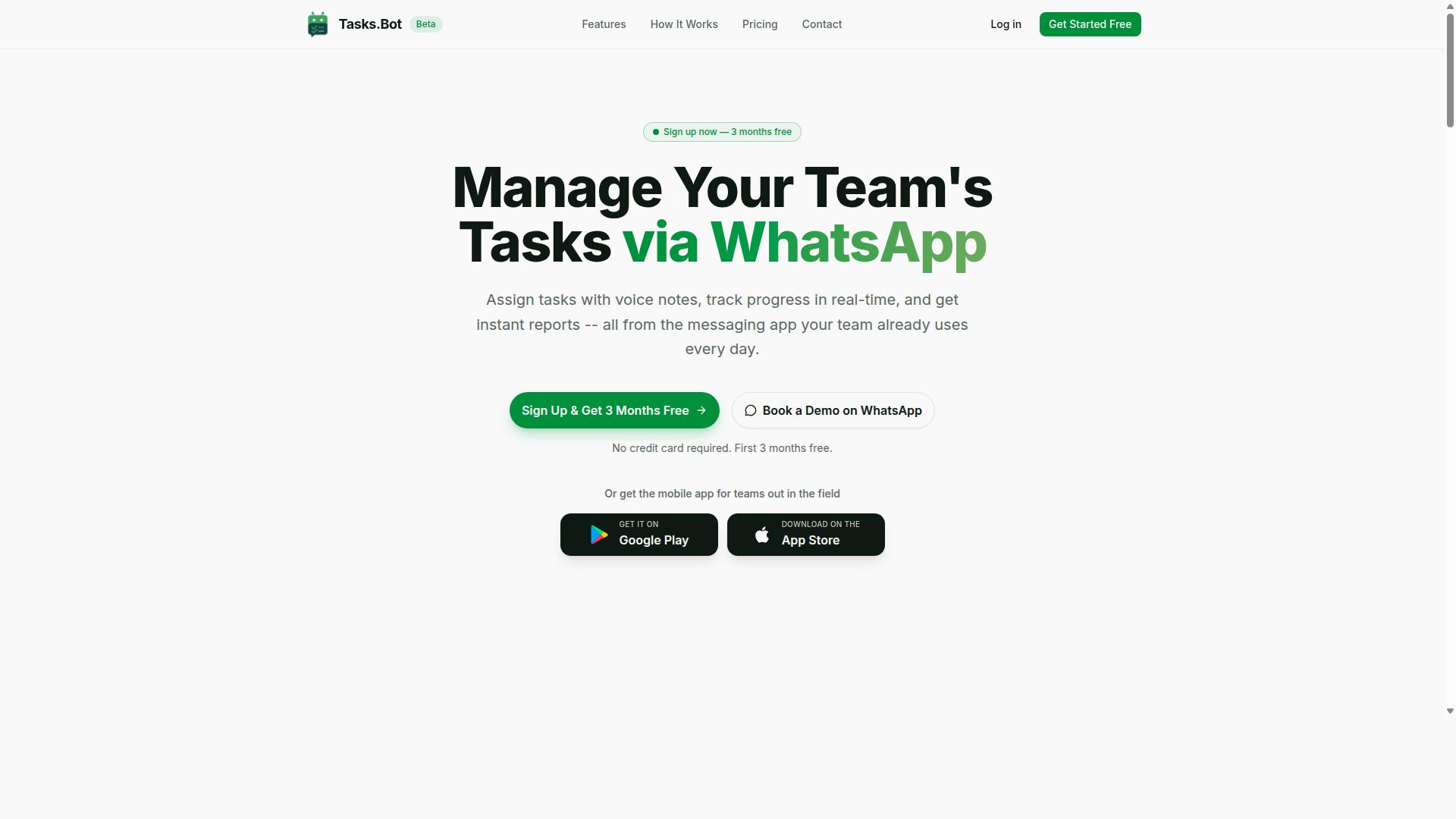
Tasks.Bot is a task management platform that runs entirely inside WhatsApp, letting teams assign tasks, track progress, and receive reports without leaving the messaging app. Instead of asking people to learn another dashboard, it meets them in a tool they already open dozens of times a day.
The core idea is simple: eliminate app-switching. When work is assigned where conversations already happen, adoption stops being a battle. There is no new login to remember and no separate inbox to check. The platform also offers a mobile app for field teams, so staff working away from a desk can stay connected to the same workflow.
Tasks.Bot is currently in beta and offers a free trial period, which matters for anyone weighing subscription costs. You can evaluate whether the tool fits your team before committing budget. For readers comparing automation and AI pricing across platforms, that trial window is the cheapest way to test real value.
This focus on WhatsApp-first operation shapes everything about who the product suits. The next section looks at the teams it was built for and how daily work actually flows through the messaging app.
Who Tasks.Bot Serves and How It Works via WhatsApp
Tasks.Bot is built for teams that rely on WhatsApp for daily coordination, especially those with field staff who need to manage tasks, track attendance, and log payroll-ready hours. If your crew already swaps updates in group chats, the platform formalizes that habit rather than replacing it.
The setup requires no new accounts or installations for team members. They simply use WhatsApp as they normally would. Tasks get assigned, progress gets tracked, and reports come back inside the same thread of communication. The mobile app covers field staff who need to manage tasks, track attendance, and log hours while on the move.
Consider a small service business. A manager assigns a job in WhatsApp. The assigned worker marks progress as the day unfolds. Attendance and hours are captured in a payroll-ready form, so month-end admin shrinks instead of piling up.
Hundreds of teams already use the service, according to the company. That adoption signal is worth noting when you compare subscription costs across automation platforms. A tool people actually open tends to deliver more value per dollar than one they avoid.
- Task assignment: work is handed out inside WhatsApp
- Progress tracking: status updates stay in the same conversation
- Reporting: summaries arrive without a separate dashboard
- Attendance and hours: captured for payroll-ready records
- Field coverage: a mobile app supports staff on the move
For teams already living in WhatsApp, the learning curve is close to zero. That low friction is exactly what makes the pricing question easier to answer. You are paying for coordination that fits existing behavior, not for a new system to maintain.
What Should You Pay for Google Sheets Automation AI? The Direct Answer
Most Google Sheets AI automation tools charge between $10 and $50 per user per month, but the true cost depends on the complexity of your workflows and the level of AI sophistication you need.
That range is a starting point, not a final number. Entry-level subscriptions usually cover a handful of automation runs, while tools built around natural language processing, API integrations, or high automation volume sit at the top of the band. Enterprise solutions with dedicated support and custom connectors routinely exceed $100 per user per month.
Cost also scales in ways the sticker price hides. Vendors often meter AI queries, workflow executions, or connected apps, so a plan that looks affordable at signup can grow expensive as usage rises.
Three variables drive most of the difference:
- AI capability. Basic rule-based automation costs far less than tools that interpret natural language or extract data from unstructured sources.
- Integration depth. Access to APIs, webhooks, and third-party connectors typically appears only in mid-range and enterprise tiers.
- Automation volume. Per-run limits and user caps determine whether a cheap plan stays cheap at scale.
One more factor matters just as much: what the headline price excludes. Add-ons, premium support, and overage charges frequently sit outside the advertised subscription, which is why the next sections break down each tier and then look at how Tasks.Bot's flat pricing compares.
Typical Price Ranges for Google Sheets AI Automation Tools
Google Sheets AI automation tools generally fall into three pricing tiers: entry-level at $10-$20 per user per month, mid-range at $20-$50, and enterprise at $50-$100+.
Each tier buys a different level of capability. Knowing what sits inside each band helps you judge whether a quote is reasonable or inflated.
Entry-level ($10-$20 per user per month). These plans usually cap automation runs or AI queries per month. You get the basics, such as simple triggers and formula assistance, but heavy usage quickly hits a ceiling. Good for individuals testing whether automation fits their workflow.
Mid-range ($20-$50 per user per month). This band typically adds API access, more triggers, and higher execution limits. Teams running recurring workflows across multiple worksheets often land here, since the extra headroom covers daily spreadsheet tasks without constant monitoring.
Enterprise ($50-$100+ per user per month). Custom integrations, dedicated support, and significantly higher limits define this tier. Organizations with compliance needs or large data volumes usually justify the jump.
Watch for add-on pricing across all three tiers. Some vendors charge extra for advanced AI models, additional connectors, or premium support, which can push the real monthly cost well above the listed rate. A $25 plan with two paid add-ons may cost more than a $50 plan that includes everything.
Why Tasks.Bot's ₹200/Month Pricing Changes the Equation
Tasks.Bot offers a full-access plan at just ₹200 per member per month, which is a fraction of the cost of typical Google Sheets AI automation tools.
Compare that against the ranges above. Entry-level tools start around $10 per user monthly, and mid-range options run $20 to $50. Tasks.Bot's monthly rate works out to roughly $2.40, and it includes AI task creation, automations, and reports without separate add-on fees.
That last point matters. Many vendors advertise a low base price, then charge extra for advanced AI models or additional connectors. Tasks.Bot's Full Access plan bundles all features into one rate, so the number you see is the number you pay.
Pricing is per member, which keeps costs predictable as a team grows. Adding seats scales the bill linearly rather than triggering tier upgrades or usage penalties.
Annual billing improves the math further. The yearly plan costs ₹1,200 per member per year, a 50% saving that works out to ₹1,200 saved annually per member compared with paying monthly.
New users also get 3 months free, with no credit card required and the option to cancel anytime. That trial period lets a team validate the workflows before committing budget.
For anyone weighing Google Sheets automation costs, the comparison is straightforward. Tasks.Bot delivers a complete feature set at a price point that undercuts even the entry tier of most competing tools, making it the clear value choice for individuals and teams alike.
Key Features and What Makes Tasks.Bot Stand Out
Tasks.Bot differentiates itself with AI that understands natural language and voice notes, plus a suite of automations and reporting tools designed for WhatsApp-first teams.
Most task managers ask teams to adopt a new app, learn a new interface, and remember yet another login. Tasks.Bot takes the opposite approach. It runs entirely within WhatsApp, so team members do not need to install anything or create new accounts.
That single design decision shapes everything else. Task creation, reminders, approvals, and reports all happen in a conversation thread your team already checks every day. For anyone weighing the cost of automation tools, that matters: you are not paying for software adoption on top of the subscription itself.
The feature set covers the full loop of getting work done:
- AI task creation from typed messages and voice notes
- Automations for assignment, reminders, and approvals
- Instant reports on team activity and performance
- Tasks on a map and a live day tracker for field visibility
- Face-verified attendance plus shifts, leave, and hours management
Android and iOS apps add push notifications, voice capture, and a home screen widget for people who want them. The core experience, however, stays in WhatsApp. Enterprise-grade encryption protects the data, and conversations and task data are never shared or used for training.
Understanding these features matters for pricing questions because they determine what you are actually comparing. A cheap spreadsheet add-on that only moves rows around is not the same purchase as a system that captures work, routes it, and reports on it.
AI Task Creation from Natural Language and Voice Notes
Tasks.Bot uses AI to parse natural language and voice notes, so you can create tasks by simply typing or speaking. No forms or complex interfaces required.
The AI understands user intent and creates tasks from messages. A sentence like "Remind John to submit the report by Friday" carries three pieces of information: the action, the assignee, and the deadline. The system extracts those details and turns them into a structured task.
Voice notes work the same way. A team member can speak a task, and the AI handles the conversion. This removes a real barrier for field staff who may not be comfortable with traditional task managers, or who are working with their hands and cannot type.
Think about what this replaces. In a spreadsheet workflow, capturing one task might mean opening a workbook, finding the right worksheet, scrolling to an empty row, and filling in several cells. Multiply that by a dozen tasks a day across a team, and data entry becomes the job.
Natural language processing cuts that friction to a single message. The practical result is that tasks actually get recorded instead of living in someone's memory or a chat scroll. The biggest failure point in task tracking is often not follow-through, it is capture. If entering a task takes more than a few seconds, people stop doing it.
This is also where the AI distinction matters for pricing comparisons. Many spreadsheet automation setups rely on rigid triggers and fixed rules. A natural language layer handles the messy, conversational way people really communicate, which is far closer to how WhatsApp teams operate.
Automations, Approvals, and Instant Reports
Tasks.Bot automates routine workflows like task assignment, deadline reminders, and approval chains, and it delivers instant reports on team performance.
Automations remove the manual follow-up that eats into a manager's day. Instead of chasing people, the system handles the routine parts:
- Automatic task assignment based on rules you set
- Smart deadline reminders that escalate as a due date approaches
- Approval workflows for tasks that need sign-off before they are considered done
Approvals deserve a closer look. When a task requires review, an approval chain keeps it from being marked complete prematurely. The sign-off happens inside WhatsApp, so nobody has to switch tools or send a separate email to confirm.
Reports are generated in real time and can be viewed within WhatsApp. That means a manager can check team performance without opening a dashboard, exporting a CSV, or waiting for a weekly summary to be compiled by hand.
Together, these features reduce manual follow-up and provide visibility without switching apps. For teams comparing costs, this is the part of the calculation that is easy to miss. The subscription price is visible, but the hours spent copying updates between systems are not.
Tasks.Bot also layers in tasks on a map and a live day tracker, which give field-based teams a view of where work is happening and how the day is progressing. Face-verified attendance and shifts, leave, and hours management round out the operational picture.
All of this sits behind enterprise-grade encryption, and the data is never shared or used for training. A 3-month free trial with no credit card required lets a team test the automations and reports against its own workflows before committing to a subscription.
Pricing and Plans
Tasks.Bot keeps pricing simple with a single 'Full Access' plan that includes every feature, available in both Indian Rupees and US Dollars. There are no tiers to compare, no feature gating, and no hidden fees added at checkout.
That structure matters when you are weighing the cost of Google Sheets automation. Many automation platforms split capabilities across starter, pro, and enterprise levels, which forces teams to guess which tier they actually need. With one plan, the decision comes down to two questions: monthly or annual, and how many members are on your team.
A currency selector lets you choose between Indian Rupee and US Dollar, so international customers are not locked into a single billing region. It is worth verifying the correct currency before you subscribe, since the displayed amount follows your selection.
The two subsections below cover the billing choices in detail: how the monthly and annual options compare, and what the free trial includes before any payment is required.
Monthly vs Annual: ₹200/Member/Month or ₹1,200/Year (Save 50%)
You can pay ₹200 per member per month, or switch to the annual plan at ₹1,200 per member per year, a 50% saving. The math is straightforward: twelve monthly payments add up to ₹2,400 per member over a year, while the annual plan costs ₹1,200. That is ₹1,200 saved per member, every year.
Both options include the same full feature set. The annual plan is not a stripped-down version, and the monthly plan is not missing anything. You are choosing a billing cycle, not a capability level.
For international customers, the same pricing is available in US Dollars through the currency selector. The structure is identical, only the displayed currency changes.
Costs scale per member, so the total depends on team size. A rough comparison:
- One member, monthly: ₹2,400 per year
- One member, annual: ₹1,200 per year
- Five members, annual: ₹6,000 per year
- Five members, monthly: ₹12,000 per year
Teams that expect to keep automating spreadsheet workflows beyond a few months will generally find the annual plan the more economical route, while monthly billing suits short projects or pilot groups.
3 Months Free - No Credit Card Required
Tasks.Bot offers a 3-month free trial with no credit card required, giving teams ample time to test the platform before committing. No payment details are needed upfront, which lowers the barrier to entry considerably.
Three months is longer than the 14-day or 30-day trials common among SaaS automation tools. That extra runway matters for spreadsheet automation, where value often shows up after a workflow has run through several real cycles of data.
A longer window lets a team connect Tasks.Bot to its actual workbook processes, observe how it handles repetitive tasks over weeks rather than days, and judge whether the results justify a subscription. You can also cancel anytime, so there is no long-term lock-in during or after the trial.
For anyone evaluating Google Sheets automation pricing, the practical sequence is simple: start the free trial, confirm the feature set fits your workflows, then choose monthly or annual billing in your preferred currency.
Trust Signals
Tasks.Bot is currently in beta, but it already serves hundreds of teams and offers a refund policy to mitigate risk. That combination matters when you are weighing any automation subscription, because you are committing budget to a tool that is still evolving rather than a finished, long-settled product. The honest framing is simple: beta status signals active development, not instability, and the refund policy gives you a defined exit if the fit is wrong.
For buyers comparing Google Sheets automation and AI pricing, trust usually comes down to three questions. Is the vendor real? Can I get my money back? Does the product handle the work I actually need done? Tasks.Bot answers each of these with verifiable details rather than vague promises.
What the beta label actually means. A beta product is one the team is still improving, which is a normal stage for SaaS tools built around artificial intelligence and natural language processing. Features may change as the platform matures. The trade-off is that you get access earlier, often at pricing that reflects an unfinished roadmap. What you should not assume is that beta equals abandoned or experimental. Hundreds of teams already rely on it for daily workflow and task automation, which suggests the core is stable enough for real operational use.
Refund protection. The site mentions a refund policy in the footer, and the details live there rather than buried in a sales page. Before you commit to any subscription, read that policy so you understand the window and the conditions. A published refund path is one of the clearest signals that a vendor is willing to stand behind its product. It also lowers the cost of trying Tasks.Bot alongside or instead of other automation platforms you may already be paying for.
Verified attendance for field teams. Tasks.Bot uses face-verified attendance for field staff. For businesses that manage remote or on-site workers, this is a meaningful accountability feature, because attendance records tied to identity verification are harder to falsify than manual check-ins. If your workflow involves logging shift data into a spreadsheet, that verification step feeds cleaner information into your workbook and reduces the cleanup that usually follows unreliable data entry.
Global access with no country restrictions. The service is available worldwide and accessible via WhatsApp, which removes two common barriers. There is no regional lockout, and staff who are comfortable with messaging apps do not need to learn a new interface. The website even includes a Book a Demo on WhatsApp option, so you can evaluate the platform through a channel you already use rather than a formal sales call.
Put together, these signals point to a vendor that is transparent about its stage, protective of buyer risk, and reachable across borders. That is a reasonable foundation for trusting a tool with your task automation and spreadsheet workflows.
Who Should Use Tasks.Bot
Tasks.Bot is ideal for teams that already use WhatsApp for communication, especially those with field staff who need task management, attendance tracking, and payroll-ready hours. The service is built around a channel those teams already open dozens of times a day, so there is no new app to install and no new habit to learn.
Because WhatsApp is the entry point, the tool fits small to medium teams better than large enterprises with layered software stacks. Hundreds of teams already use the service, which suggests the model works across a range of small and mid-sized operations rather than a single niche.
Below are the groups that get the most value, along with the situations where a different kind of tool makes more sense.
- Field services: technicians, cleaners, and maintenance crews who move between job sites and need to log tasks and hours from a phone.
- Retail: store teams coordinating shift tasks, opening and closing checklists, and attendance.
- Logistics: drivers and warehouse staff tracking assignments and time on the road or floor.
- Remote teams: any distributed group that already runs its day-to-day communication through WhatsApp.
The common thread is a workforce that is mobile, distributed, or both. When staff are not sitting at a desk, a spreadsheet or a browser-based project board often goes unused. A messaging app they already carry becomes the practical place to assign work and record hours.
Tasks.Bot is also global and works anywhere WhatsApp is available. That matters for teams spread across regions, since the tool follows the messaging app rather than a specific country or office setup.
It is less suited to teams that do not use WhatsApp at all. If your communication already lives in email, Slack, or another channel, the core advantage of Tasks.Bot disappears, and you would be adding a tool rather than meeting people where they already are.
Teams that need deep integration with other project management tools should also weigh their options carefully. Tasks.Bot focuses on task management, attendance tracking, and payroll-ready hours through WhatsApp, so organizations with complex dependencies, sprint planning, or heavy cross-tool workflows may find a dedicated project platform a better fit.
The clearest sign you are the right user is simple. If your team coordinates work in WhatsApp and struggles to capture hours or task status reliably, Tasks.Bot is built for exactly that situation.
Final Verdict
Tasks.Bot offers a compelling alternative to traditional Google Sheets AI automation tools, especially for WhatsApp-centric teams that need affordable, AI-powered task management. At ₹200 per month, it delivers AI task creation, automations, and reports without the complexity of spreadsheet formulas, Apps Script, or third-party connectors.
For many teams, the real pain of Google Sheets automation is not the software itself. It is the cost stack that builds up around it, including subscription tiers, API usage, add-ons, and the time spent maintaining scripts. Tasks.Bot sidesteps most of that by keeping everything inside WhatsApp, a tool your team already uses daily.
Here is a quick recap of what shapes the pricing decision:
- Simplicity wins on cost. Tools like Zapier, Make, and n8n can automate Google Sheets, but pricing often scales with tasks, operations, or workflow complexity. Tasks.Bot charges a flat ₹200 per month.
- AI task creation is built in. Instead of writing formulas or configuring triggers, users describe what they need in natural language and let the AI handle it.
- Automations and reports stay in one place. No separate dashboard, no spreadsheet maintenance, no connector fees.
- WhatsApp is the interface. This removes the learning curve that comes with script editors, webhooks, and range references.
The verdict is straightforward. If your team lives in WhatsApp and wants AI-powered task management, automations, and reports at a predictable, low cost, Tasks.Bot is the clear choice. The ₹200 monthly price removes the guesswork that makes Google Sheets automation budgets hard to forecast.
If your needs lean heavily toward advanced Google Sheets integrations, deep API access, or complex complicated processes across many SaaS platforms, it is worth evaluating other tools built specifically for that depth. Those setups usually cost more and require more technical upkeep, but they serve a different purpose.
For everyone else, especially small teams and founders who want results without spreadsheet overhead, Tasks.Bot keeps things simple and affordable. To learn more or see it in action, reach out directly:
- Phone: +91 97143 42522
- Email: [email protected]
The fastest way to understand the value is to book a demo on WhatsApp. You will see how AI task creation, automations, and reports work together, and you can decide whether the ₹200 monthly plan fits your workflow.
Frequently Asked Questions
How much does Tasks.Bot cost compared to other Google Sheets automation and AI tools?
Tasks.Bot keeps pricing simple with a single 'Full Access' plan that includes all features - ₹200 per member per month, or ₹1,200 per year per member (a 50% saving on the annual plan). Pricing is available in both Indian Rupees and US Dollars. Since other tools vary widely in how they charge, compare on total cost for your whole team rather than headline rates.
Do I need to install new software or create accounts for my team to use Tasks.Bot?
No. Tasks.Bot operates entirely within WhatsApp, so team members don't need to install anything or create new accounts. There's also a mobile app for field teams who need it. This makes rollout far faster than tools that require every team member to adopt a new platform.
What does Tasks.Bot actually automate with AI?
Tasks.Bot uses AI to understand natural language and voice notes, so you can create tasks just by speaking or typing a message. It also handles automatic task assignment, smart deadline reminders, approvals, automations, and instant reports. For teams already communicating on WhatsApp, this means task management happens where the conversation already is.
Is Tasks.Bot only for task management, or does it cover attendance and field teams too?
Beyond task management, Tasks.Bot offers face-verified attendance, live day tracking, tasks on a map, and payroll-ready hours. These features are designed for teams with field staff who need both task tracking and attendance in one place. Everything is included in the single 'Full Access' plan.
How do I figure out what my team should actually pay?
Start by counting the members who need access, then multiply by the per-member rate - Tasks.Bot's pricing scales per member, so cost grows with your team size. If you're comparing against other tools, factor in setup time and training, since Tasks.Bot runs inside WhatsApp with no new accounts required. You can book a demo on WhatsApp to see how it fits your workflow before committing.
Is Tasks.Bot available in my country, and can I try it first?
Tasks.Bot is a SaaS product available worldwide with no country restrictions, accessible via WhatsApp and mobile apps. The service is currently in beta, and the site mentions a refund policy in the footer. You can reach the team at [email protected] or +91 97143 42522, or book a demo on WhatsApp to get started.
Recommended Resources: